HFSAA-Certified Halal Meat & USDA-Inspected Facility
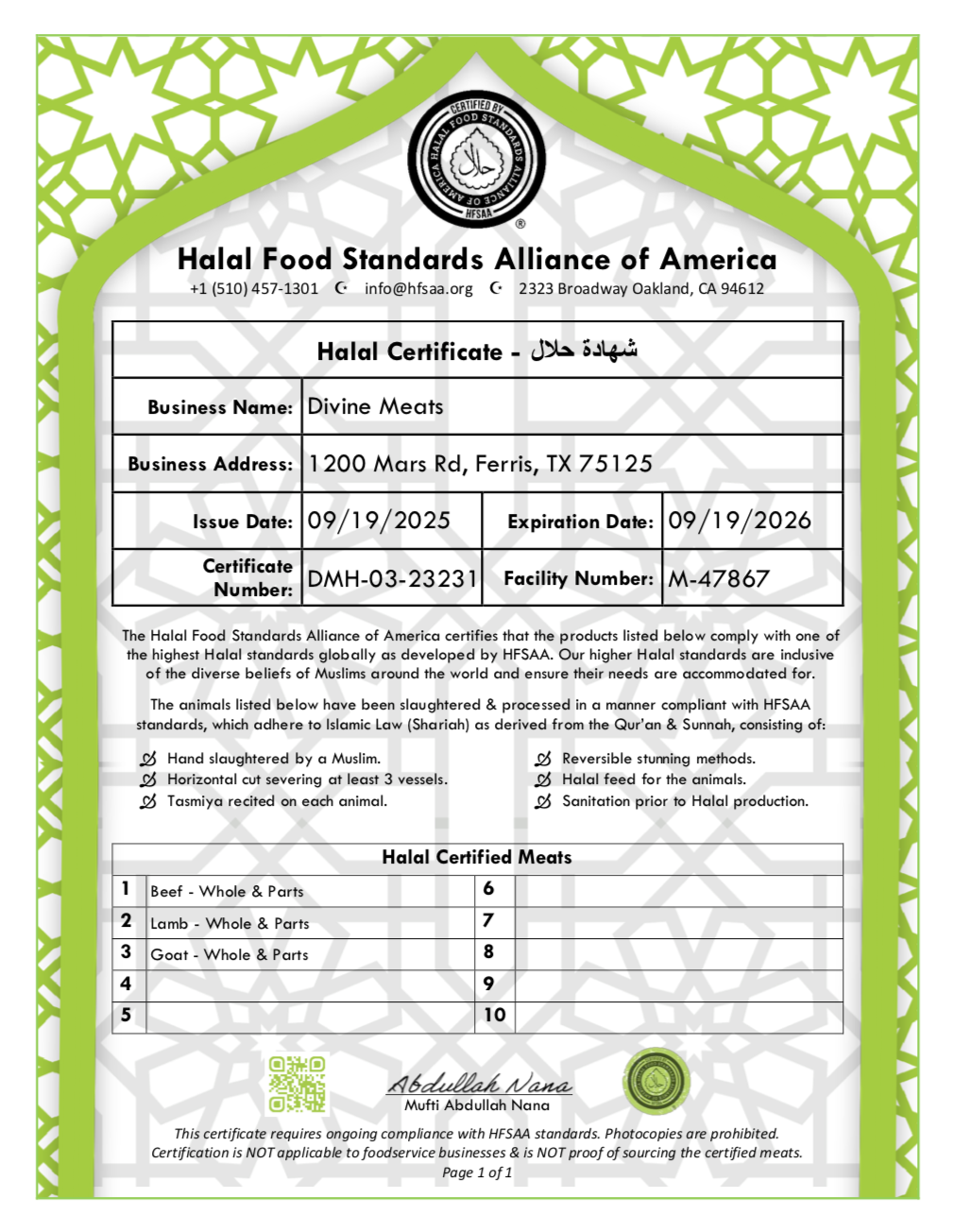
Our Certifications: Trusted, Verified, and Transparent
Divine Foods is proud to uphold the highest standards in halal integrity and food safety. We are:
Certified by the Halal Food Standards Alliance of America (HFSAA)
Our facility follows strict Halal guidelines: all animals are hand-slaughtered by Muslims, with no stunning, full tasmiyah recited, and all major vessels cut while facing the Qiblah.
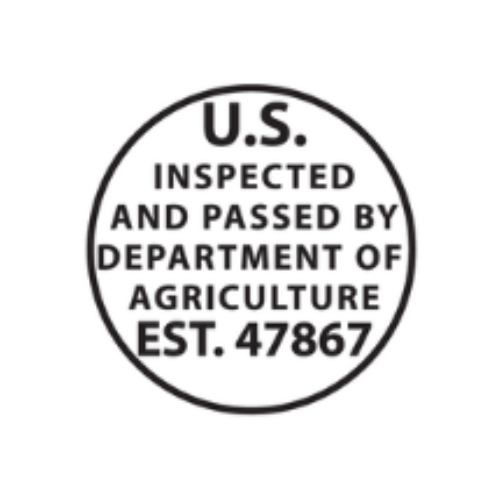
USDA-Inspected Facility (Est. 47867)
All meat is processed under direct USDA supervision, ensuring compliance with rigorous federal standards for safety, hygiene, and traceability.
Verified Vendor with the U.S. Federal Contractor Registration (USFCR)
Our active vendor status confirms our eligibility to operate within federal systems and our commitment to transparency and regulatory compliance.
These certifications reflect our commitment to delivering meat that is halal, clean, ethical, and trustworthy from start to finish.
HFSAA-Certified Halal Meat You Can Trust
At Divine Foods USA, halal is not simply a label placed on a package. It is a sacred responsibility that guides how our animals are handled, how every slaughter is performed, and how our meat is processed from beginning to end.
Our facility is certified by the Halal Food Standards Alliance of America, commonly known as HFSAA. HFSAA is a nonprofit halal-certification organization established and supervised with the involvement of Islamic scholars, professionals, inspectors, and community leaders. Its mission is to provide transparent and verifiable halal standards that address the concerns of Muslim consumers from diverse backgrounds.
Located in Ferris, Texas, Divine Foods provides HFSAA-certified Halal beef, lamb, and goat for families, grocery stores, restaurants, wholesalers, distributors, and community organizations seeking meat prepared with faith, integrity, and accountability. Divine Foods also operates as a USDA-inspected establishment.
What HFSAA Certification Means
HFSAA certification provides independent verification that halal standards are being followed throughout the certified operation. Instead of asking customers to rely only on a company’s own halal claim, certification adds an outside layer of review, accountability, and transparency.
HFSAA’s published slaughter standards include several essential requirements:
The person performing the slaughter must be Muslim.
The animal must be slaughtered by hand rather than by a mechanical rotating blade.
A sharp knife must be used to perform the proper horizontal throat cut.
The required throat structures and major blood vessels must be severed according to HFSAA standards.
The name of Allah must be recited with the proper intention for every individual animal.
A recording, written blessing, or single general recitation does not replace tasmiyah by the person carrying out the slaughter.
These requirements help preserve the religious integrity of Halal hand-slaughter and give Muslim consumers greater confidence about how their food was produced.
Divine Foods’ No-Stunning Commitment
Although HFSAA may approve certain reversible stunning methods under strict conditions, Divine Foods does not stun animals before or after slaughter. This is a deliberate facility policy and an important part of our commitment to traditional Zabiha Halal practices.
Every animal must be alive and healthy at the time of slaughter. By maintaining a no-stunning process, Divine Foods removes uncertainty about whether stunning may have injured or killed the animal before the cut. HFSAA itself distinguishes between reversible and irreversible stunning and does not approve methods that cause the animal’s death before slaughter.
For customers specifically searching for non-stunned halal beef, lamb, and goat, our process offers a clear and transparent choice.
Hand-Slaughtered by Trained Muslims
Every animal processed under our Halal program is slaughtered individually by a trained Muslim slaughterer.
We do not use mechanical slaughter blades. The person performing the slaughter makes the cut directly by hand, allowing the slaughterer to maintain intention, pronounce the name of Allah, and give personal attention to each animal.
This distinction matters because HFSAA does not consider a general blessing at the beginning of a mechanical production run to be equivalent to tasmiyah pronounced for each individual animal by the actual slaughterer.
Tasmiyah Recited on Every Animal
Before each slaughter, the Muslim slaughterer audibly recites the name of Allah—“Bismillah, Allahu Akbar”—with the proper intention.
The tasmiyah is not played through a recording, printed on equipment, or recited once for an entire group of animals. It is pronounced individually as each animal is slaughtered.
This individual recitation is central to Divine Foods’ understanding of authentic Halal preparation and aligns with HFSAA’s published requirement that the name of Allah be recited for every individual animal.
A Proper Halal Cut
Using a clean, sharp knife, the slaughterer performs a swift horizontal cut across the throat. The cut severs the required structures, including the trachea, esophagus, and carotid arteries, in accordance with HFSAA’s slaughter standards.
The process is performed carefully and purposefully, with respect for the animal and attention to both Islamic requirements and food-safety procedures.
Divine Foods does not use vertical cattle sticking, modified vertical cuts, mechanical slaughter, or partial cuts that fail to meet the required standard.
Facing the Qiblah
As part of Divine Foods’ faith-based slaughter procedure, each animal is positioned toward the Qiblah, the direction of the Kaaba in Makkah, before slaughter.
Facing the Qiblah reflects reverence, intention, and respect for the sacred nature of the act. It is one of the ways our team goes beyond treating halal as a production claim and instead approaches it as an act of worship and responsibility.
This should be described as a Divine Foods practice, rather than as a universal HFSAA certification requirement.
Why Independent Halal Certification Is Important
The word “halal” can sometimes be used without clearly explaining who performed the slaughter, whether the animal was stunned, whether a machine was used, or whether tasmiyah was pronounced for every animal.
Independent certification helps answer those questions.
For Muslim families, it provides greater confidence that the meat they place on their tables aligns with their religious values. For retailers, restaurants, and distributors, certification provides documentation from an outside halal authority instead of relying solely on an unverified supplier statement.
HFSAA describes its role as establishing transparent and verifiable halal standards so consumers can make informed purchasing decisions.
Halal in Name and Halal in Practice
At Divine Foods, we believe consumers deserve more than a halal logo. They deserve to know:
Who slaughtered the animal
Whether the slaughter was performed by hand
Whether stunning was used
Whether tasmiyah was recited for every animal
Whether the correct Zabiha cut was completed
Whether halal integrity was maintained through processing and packaging
That is why transparency is at the center of our process.
Our HFSAA certification, no-stunning policy, Muslim hand-slaughter process, individual tasmiyah, Qiblah-facing practice, and USDA-inspected operation work together to provide meat that customers can purchase with greater confidence.
Serving Families, Retailers and Wholesale Halal Buyers
Divine Foods supplies Halal:
Beef
Lamb
Goat
Whole carcasses
Boxed meat
Bone-in and boneless cuts
Ground meat
Organ meat
Custom butcher cuts
Our products are available for grocery stores, halal markets, restaurants, food-service operators, distributors, institutions, community organizations, and qualified wholesale customers.
Choose Halal Meat Prepared with Faith and Accountability
When you purchase Divine Foods products, you are choosing meat prepared through a documented process grounded in Islamic principles, independent halal certification, federal inspection, and a commitment to transparency.
HFSAA-certified. Hand-slaughtered by Muslims. No stunning. Individual tasmiyah. Facing the Qiblah. Halal integrity from our facility to your table.
Contact Divine Foods USA to become a retail, restaurant, distribution, or wholesale customer.
Frequently Asked Questions
What is HFSAA certification?
HFSAA certification is independent halal verification provided by the Halal Food Standards Alliance of America. HFSAA publishes standards covering the slaughterer, method of slaughter, tasmiyah, the required cut, ingredients, and other halal-compliance concerns.
Is Divine Foods meat hand-slaughtered?
Yes. Divine Foods states that its beef, lamb, and goat are slaughtered individually by trained Muslim slaughterers rather than by mechanical slaughter equipment.
Does Divine Foods stun animals?
No. Divine Foods maintains a facility-specific policy of no pre-slaughter or post-slaughter stunning.
Is tasmiyah recited for every animal?
Yes. The Muslim slaughterer recites the name of Allah for each individual animal. This aligns with HFSAA’s published standard requiring individual tasmiyah with the proper intention.
Are the animals faced toward the Qiblah?
Yes. Divine Foods positions animals toward the Qiblah as part of its own faith-based slaughter procedure.
Where is Divine Foods located?
Divine Foods operates its USDA-inspected halal meat facility in Ferris, Texas, serving retail, restaurant, wholesale, and community customers.